
Armenia’s relations with Europe are at a historic high, with rapidly growing public support towards the European Union, at a time when Yerevan is struggling with existential issues in the face of continued hostility from its neighbours, especially Azerbaijan, a senior diplomat has said.
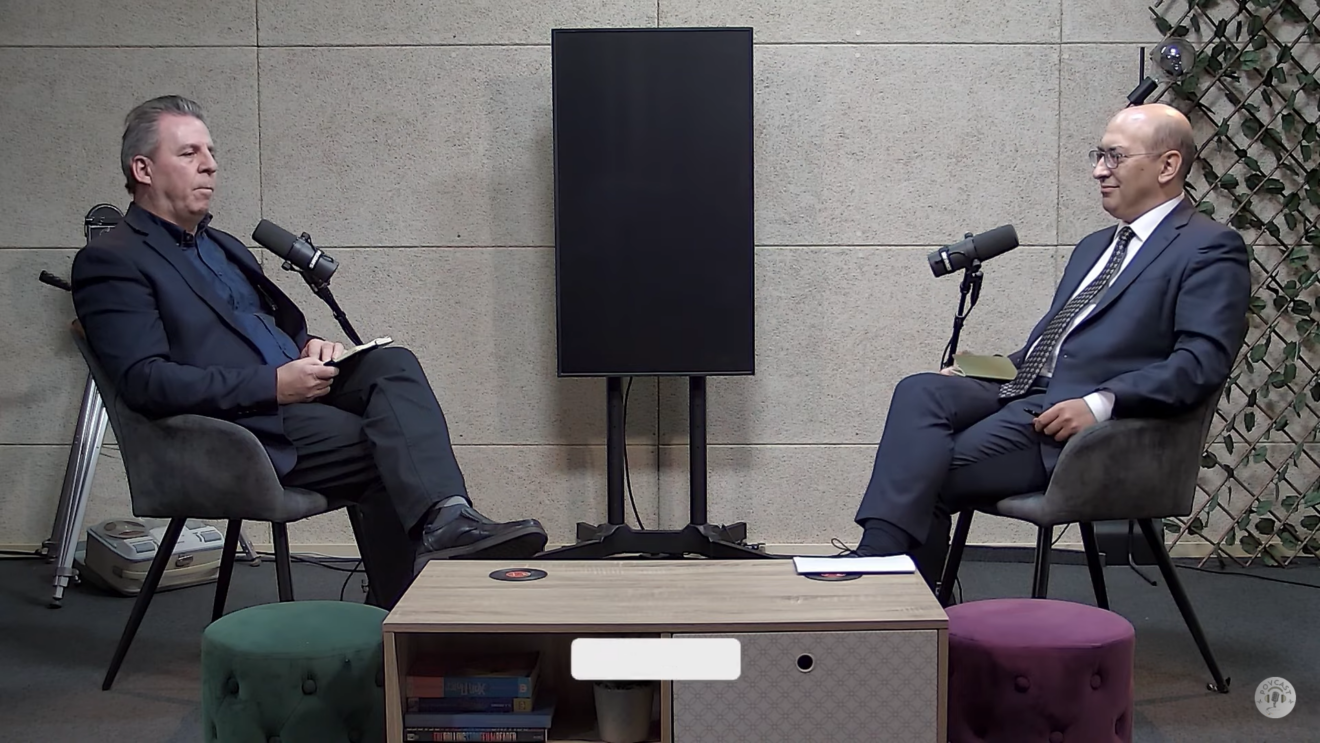
In an interview with the Financial Mirror’s “Off the Wall” podcast, Ambassador Tigran Mkrtchyan said that, “never, in the past, has the level of our relations been so intense and so close, and on a qualitatively very high level.”
“We have been actively engaged in our cooperation with the EU within the CEPA framework, the Comprehensive and Enhanced Partnership Agreement, but now we are talking already about enhancing this engagement with a new partnership agreement.”
Ambassador Mkrtchyan, who is resident in Athens and also accredited to Albania, emphasised several “important” developments in relations with the EU, such as the ratification of the Rome Statute, the Europol or Eurojust agreements, Armenia joining the Common Aviation Area and being granted with the European Peace Facility.
“The EU Mission of Armenia monitoring the border areas with Azerbaijan has been prolonged for another two years, despite the somewhat, not very much encouraging approach of Azerbaijan.
“And, of course, the launch of the visa liberalization VLD process, which hopefully will mature. The negotiations are to be conducted in the coming months, years, maybe, but hopefully the sooner, the better, because, this will immensely contribute to the people-to-people contact between Armenia and the EU.”
Mkrtchyan said that recent surveys indicate that, “the Armenian society is very much proving or showing, that the country’s moving in a European direction, getting closer to Europe, adhering to European values and European reforms.”
At the same time, bilateral relations between Armenia and Cyprus, and Armenia and Greece are extremely important in the dynamic process taking place in the relations between Armenia and the EU.
“Greece and Cyprus are essential partners of Armenia in the EU, big supporters of Armenia, in all discussions related to Armenia within this institution.”
Mkrtchyan added that Cyprus has been of immense support to Armenia.
“We have never encountered the word “no”. And this has been reciprocated. Armenia has always stood by Cyprus, be that on bilateral or on international, multilateral formats.
Ambassador ‘long overdue’
He said that the appointment of Yerevan’s first resident ambassador to Cyprus “was long-overdue, because we have been discussing this necessity for three decades.
“This has been a topic of talk in the corridors of the Cyprus Foreign Ministry as well, regarding reciprocation in Armenia. And, fortunately, over the recent years, these talks were accelerated.
“Cyprus appointed a resident ambassador, Michalis Mavros, who has been in Armenia since September 2024. And just recently, my colleague Inna Torgomyan, a career diplomat and a friend, was appointed as ambassador to Cyprus. She will proceed from where we have left off, but on a new, completely fresh basis, with a a much more enhanced status.
“This was a necessity and long overdue. Cyprus has been a very close friend of Armenia and Armenians for centuries.”
Mkrtchyan said Cyprus is encouraging Armenia’s reforms agenda, is supporting Armenia’s adherence to peaceful development of the South Caucasus region, including the Crossroads of Peace initiative.
He said there has been trilateral cooperation in the defence sector between Cyprus, Greece and Armenia, “and probably the defence sector cooperation could an example of other action plans, meetings, consultations and engagement.
The Ambassador explained that the Crossroads of Peace initiative was proposed by the Prime Minister of Armenia in October 2023, at the Tbilisi Silk Road Forum. The philosophy is that the region, instead of being a hotbed of conflicts, disagreements, wars and suffering, has the potential of becoming an area of economic cooperation, peaceful engagement, opening of transport routes, be they railways, pipelines or electricity lines.
“Artificially circumventing Armenia, just because there are disagreements or hostility towards Armenia, is not helping at all in making the region, an area of peace or cooperation.
“Armenia has no disagreements or problems with its neighbours, Iran and Georgia. We have had traditionally very close relationships. And the borders continue to be closed with Turkey, and borders with Azerbaijan need to be fully demarcated, and, a peace agreement needs to be signed.”
“There has been a lot of positive reaction to it, including from, Greece and Cyprus, Georgia and Iran.
“We need to ultimately persuade our colleagues especially in the east, and of course, Turkey can be of utmost importance in this. Once everybody agrees, this will be a great idea which can be implemented. But let’s see how we progress in terms of the peace agreement being negotiated between Armenia and Azerbaijan.
“There is apparently a draft agreement which has been negotiated over the past few years. Two of the 17 articles are not yet finalised. Armenia has sent its version of these articles to Azerbaijan a couple of months ago. We haven’t had answers from Azerbaijan.
Demarcation and delimitation
“Of course, also very important is that the demarcation and delimitation commissions from both sides are meeting, and there is work going on in this sphere. A lot needs to be done because only a very small part of the border has been demarcated in the north-east.
“There is also the presence of EU observers, which contributes to peace, but, unfortunately, we have sometime heard from the Azerbaijani side, very aggressive and hostile reaction to this mission, which raises eyebrows.
“No reasonable person could think that Armenia would be attacking Azerbaijan. And, the Azerbaijani attitude of questioning the European mission’s existence within the territory of Armenia raises a lot of questions because the mission is not doing anything against Azerbaijan. The mission is simply contributing to the safety and security of the borders between Armenia and Azerbaijan. They are neutral. They are not working for Armenia or for Azerbaijan nor against Armenia or against Azerbaijan.
“It would have been better if there was a similar mission, for example, in Azerbaijan. And initially, if I’m not mistaken, Azerbaijan agreed to hosting such a mission in 2022, but then it backtracked.
“The most important thing is political will and the need for confidence-building, whether Azerbaijan will find the strength to move forward, normalise relations with Armenia, sign the peace agreement and put aside its aggressive, hostile rhetoric.
“Because for some time there was a very hostile and aggressive rhetoric, containing territorial claims towards Armenia, questioning Armenia’s sovereignty and territorial integrity, and interpreting historical events in a very imaginative way, completely disconnected from reality.
“This kind of rhetoric, and constantly threatening Armenia, is not constructive. You don’t choose neighbours. You have the neighbours you have, to coexist and cooperate. And, Armenia’s stance is not to reciprocate in terms of this polemic. There are indeed so many counter-arguments that we will never finish in terms of discussing how Azerbaijan was originated and how it developed.
Defence reforms
Ambassador Mkrtchyan said that Azerbaijan has been questioning Armenia’s defence reforms, arguing that Armenia doesn’t have the right to buy any types of weapons.
“Armenia has been implementing defence reforms, and it has every sovereign right to do so. It’s the right and duty of every country’s leadership to make sure that the security of its own people is guaranteed, and for that purpose, purchasing defensive systems or capacities is an inherent right of every country.
“We are not raising the question, why has Azerbaijan since 2020, been arming itself, in a very accelerated mode acquiring a lot of very advanced offensive weaponry, from around the world. Why are you then questioning if the other side is trying to make sure that its survival is not questioned? This is simple logic.
As regards the Armenians from Nagorno-Karabakh held captive and facing puppet trials in Azerbaijan, the ambassador said that the world is witnessing what’s happening in Baku.
“We’re trying not to make the plight of the prisoners any worse. And this is what has become an issue in the Armenian internal political discussion, but everybody sees that the situation is getting worse. These are fake trials, and hopefully, they will end as soon as possible, and the detainees will be returned.
“We see that there is a lot of suffering in their faces, in their conditions of imprisonment. Unfortunately, we also know what’s going on with the Armenian Christian and cultural heritage in Nagorno-Karabakh. This is also something extremely worrying, with UNESCO having no access to these areas. This vandalism is not going to help anyone.
“This zero-sum mentality that, my opponent’s loss is my victory, which has been dominating the political mindset of some of the leaders in our region, needs to be erased.
“We have seen suffering for a very long time. These sufferings are still going on. There are still more than 120,000 Nagorno-Karabakh refugees in Armenia. But in an engaging manner, and with the hope that we can reach some sort of an agreement, without undermining each other constantly and without threatening at least our mutual existence. From the Armenian side, there is no such threat against Azerbaijan. So, let’s be clear about that. What we need to do is to bring Azerbaijan more to a constructive field.