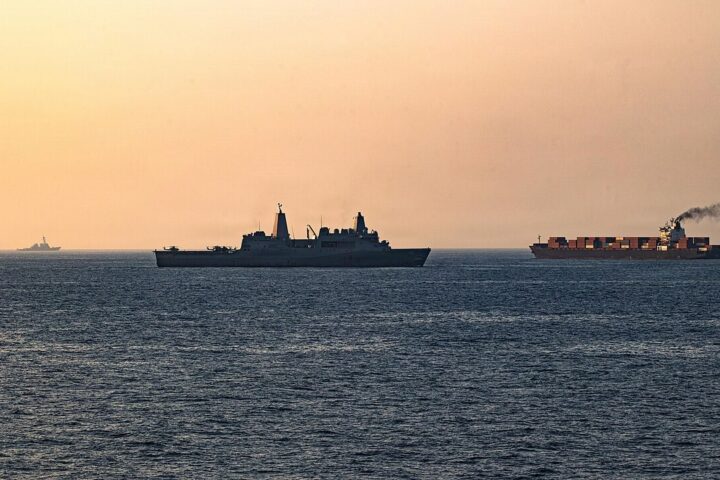

The seizure of Venezuelan oil resources by the U.S. signals a broader shift towards a ‘smash-and-grab’ diplomacy in a world of resource scarcity, that is likely to accelerate similar behaviour by other states.
Brent crude’s price climbed as markets priced in a mix of supply disruption and geopolitical risk – now at $69.40/b.
But Shell CEO Wael Sawan highlighted how little oil prices have moved, staying around $60-70/b, despite the huge increase of geopolitical risk and the use of sanctions. The market is far more stable than in the past, as regards political risk.
Oil prices slid after the IEA cut its 2026 demand growth forecast to 850,000 bpd, down from 930,000 bpd previously, while global supply is still set to rise by about 2.4 million bpd. Traders took the softer demand outlook as a cue to sell.
OPEC+ decided to keep production flat in March and reaffirmed its Q1 pause on supply hikes at its February 1 meeting. Delegates said the group sees no need to change course despite oversupply fears and rising geopolitical risks in Iran and Venezuela. Oil prices so far appear to support that.
Vitol said tightening sanctions on Russian and Iranian oil are effectively removing about 1 million bpd of supply as buyers shift toward western and Saudi barrels, keeping oil prices supported despite oversupply fears. Tankers laden with crude sit idle near China amid demand shifts.
In a world of increased political volatility, excess oil supply could disappear quickly for any number of reasons, from supply disruption in Iran to more turmoil in Latin America.
Vitol now expects global oil demand to peak in the mid-2030s, at 112 mln bpd, pushing back its prior outlook by several years. Slower electric vehicle (EV) adoption and a shift toward energy security and competitiveness mean demand in 2040 could still be 5 mln bpd higher than today.
Oil demand is bifurcating. It is falling in rich countries, but rising in developing ones. That flips leverage, concentrates risk, and makes geopolitics matter more, not less.
Sustained oil prices near $60/b are squeezing European oil majors’ cash flows.
BP, Shell, TotalEnergies, Equinor and Eni are cutting share buybacks by 10-25% as payouts become harder to sustain.
API CEO Mike Sommers warned that reviving Venezuela’s oil industry will be a long, multi-billion-dollar effort, not a quick win. Small gains (100-200,000 bpd) are possible, but restoring peak output would require legal certainty, security from expropriation, and massive infrastructure.
Venezuela’s “largest oil reserves in the world” claim is deeply misleading. About 90% of that is extra-heavy crude that’s expensive, energy-intensive, and uneconomic at $60-65/b. Without sustained high oil prices and political stability, large-scale production growth is a fantasy.
Exxon, Chevron, Shell, BP and Total generated $96 bln in free cash flow in 2025, nearly matching 2008 levels when oil galloped to $100/b, thanks to mergers, layoffs and exiting weak low-carbon bets. With lower prices ahead, maintaining such profits and buybacks will be harder in 2026.
US shale growth is over and we are now entering a post-US shale world. The challenge? With peak non-OPEC production also happening this year, OPEC will get back into the driving seat, and the oil price could begin a powerful multi-year run.
Also, after a year of shortages, Russian diesel is back.
Faster-than-expected refinery repairs lifted output and stocks, reviving exports and reshaping trade flows to markets like Brazil. The result: softer diesel cracks heading into 2026, despite sanctions pressure.
Meanwhile, global oil discoveries are shrinking, as a result of decreasing exploration activity and depletion of the largest, easiest to find fields. To fix this, we need high enough oil prices for long enough to induce an oil exploration boom.
With oil majors ready to take on the investment risk, oil-rich Libya is emerging from years of economic devastation back to the global energy map as an attractive prospect.
Libya announced a 25-year deal with TotalEnergies and ConocoPhillips to lift output from the Waha oilfields to approx.. 850,000 bpd, more than double current output.
China is also playing a role as a pressure valve in the sanctioned crude market.
It has an entire “shadow fleet,” which is used to ship sanctioned oil, especially Iranian, making it the key destination, absorbing around 55% of global seaborne sanctioned exports since 2023.
Oil shaped the last century, but rare earths may shape the next. As economies electrify and artificial intelligence (AI) expands, control over critical materials is becoming a new source of global power.
Dr Charles Ellinas, Councilor, Atlantic Council
X: @CharlesEllinas