We have already entered the third week of the Iran war and there is no sign yet that it is coming to an end.
The continuing contradictory statements by President Trump keep confusing the markets, as ween by the extreme volatility of the Brent oil price. The benchmark crude has steadily increased from $72 a barrel at the start of the war, rising to $85/b by March 6, then surging to $120/b on the 9th, before dropping back to $85/b a day later.
And by March 13, it had settled at just over $100/b, all in reaction to Trump’s statements.
If anything, the bombings of Kharg Island and Isfahan is leading to further escalation.
With political pressure building up in the U.S. over soaring oil costs, Donald Trump has suggested he will end the war “soon.” But finding an acceptable end could be difficult.
Key to developments
One of the critical issues of the conflict is the risk of escalation through attacks on energy infrastructure. This has already started, with Israel striking a natural gas processing facility at the South Pars Gas Field, the Fajr-e Jam Gas Refinery in Bushehr province, and the Shahran oil depot just north of Tehran, all causing explosions and fires.
With the U.S. now attacking Kharg Island, Iran’s most important oil export facility, escalation is already unfolding. Fujairah oil terminal, a critical hub for UAE oil exports, was hit in retaliation.
Iran has been escalating attacks on Gulf refineries, energy production, processing and oil storage facilities, Qatar’s Ras Laffan LNG plant and tankers inside the Gulf in response to ongoing US-Israeli attacks.
And on Friday, an Iranian drone strike caused chaos in Dubai’s financial district, escalating the war even further. Iran has threatened to start heavy striking of strategic oil infrastructure and U.S. targets in GCC countries around the Gulf.
If the Houthis in Yemen also join the war and close Bab al-Mandab, that would make the Red Sea another choke point. They have already hit a Liberian-flagged oil tanker in the Red Sea.
As the FT pointed out, closing the Strait of Hormuz and attacks on neighbouring countries’ energy and now on commercial assets, is a mark of how existential a struggle the war has become for Iran’s regime.
It is now a matter of endurance and survival. Merely enduring this conflict is considered a significant victory, regardless of the cost or damage.
This is why Wall Street has warned that the Iran war will trigger a prolonged energy crisis.
Impact on oil supplies
The war has caused a serious problem with worldwide oil supplies.
The Strait of Hormuz is effectively closed – something that never happened before – stopping about 20 mln barrels per day (mb/d) from reaching markets, the largest ever disruption in the history of the oil market.
About 4-5 mb/d can bypass the Strait through Saudi Arabia’s East-West Pipeline, with Iran still exporting 1.5 mb/d to China. That leaves 14-15 mb/d oil that cannot reach markets, as long as the Strait remains closed.
This cannot be replaced by additional production from other countries and sanctioned oil in ships at sea. The quantities involved could only cover a week or so of lost exports.
The release of oil from strategic reserves can help, but it depends on duration and rate of release.
All of these still leave a deficit of about 10 mb/d that cannot be replaced. That is why prices have risen to the $100/b mark.
And it is not just oil and gas that is being affected.
Shipments of many essential materials from the Gulf, especially ammonia and urea representing about 30-40% of global exports, sulphur about 40%, helium about 25% and methanol about 20%-30%, have also been heavily disrupted. This has caused havoc for global supply chains and impacting Asia’s and Europe’s petrochemicals industry.
Release of strategic oil reserves as a stabilisation tool
The International Energy Agency, together with the U.S., agreed to release about 400 mln barrels from strategic oil reserves, with the latter starting as early as this week.
But other countries need anything from days to even a few weeks to start releasing their reserves. As a result, 1-1.5 mb/d could start being released in a week, ramping up to 2-2.5 mb/d in up to three weeks.
Not only is the timing of no help, but quantities are small compared to the 14-15 mb/d export deficit, as long as the Strait of Hormuz remains closed. That is why the IEA’s oil release announcement underwhelmed markets.
Most analysts believe the IEA stocks are just a band aid that can soften the blow from the current crisis for only a short period. Soon after it was announced, the price of oil jumped to over $100/b in response to Trump’s statements.
Tapping strategic reserves will slow, rather than stop, rising oil prices and offer a temporary salve.
How high could Brent go?
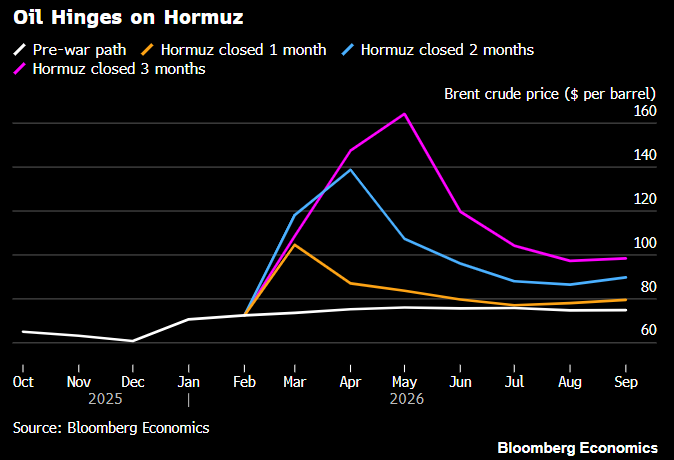
How high the Brent crude price will go depends heavily on how long the Strait of Hormuz remains closed. Analysis by Bloomberg suggests that a one-month closure would get Brent to $100-105/b, two months to $140/b and three months to $164/b. Goldman Sachs agrees.
 In addition, the longer it takes to open the Strait, the longer it will need for prices to fall back. It also depends on how long it will take producers to ramp-up production after the Strait opens.
Where facilities are completely shut-down, it could take another 1-3 months to restart them and return back to normal production levels. That’s why closure of the Strait by more than a month would keep prices higher for longer.
Supply-chain disruptions, from misplaced ships, canceled insurance, and slowed output in Saudi Arabia, Iraq, Kuwait and the UAE, will take months to fix.
Bloomberg estimates that a one-month delay would see prices returning to normal by July, two months would keep prices to about $90/b by September and three months between $90 and $100/b by September.
The consequences of the war for oil and gas prices are uncertain, but could rival those that followed Russia’s invasion of Ukraine in 2022. Much will depend on whether the disruption is short-lived and the state of infrastructure around the Gulf at the end of it.
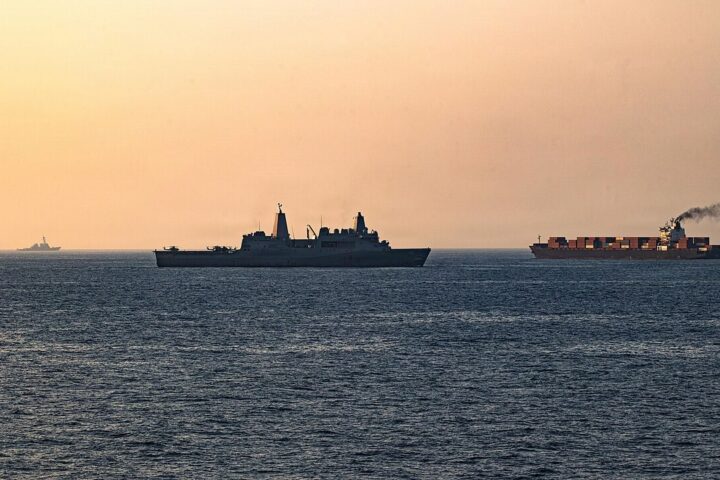
The U.S. is considering providing naval escort to ships prepared to go through the Strait, probably by the end of March, but with Iran deploying mines, they will still face high risks. Iran is also still capable of unleashing a large number of suicide boats and drones from underground tunnels along its coast capable of striking ships across the Gulf.
Even if naval escort is provided, ships would have to decide whether to take such risks.
Vastly increased war-risk insurance premiums are also a problem, even with the U.S., and possibly Europe, prepared to offer alternatives.
Reducing oil prices really comes down to ending the war. All other options are not guaranteed to work.
Oil traders still appear to be betting that that will be the case and soon.
Dr Charles Ellinas, Councilor, Atlantic Council
X: @CharlesEllinas