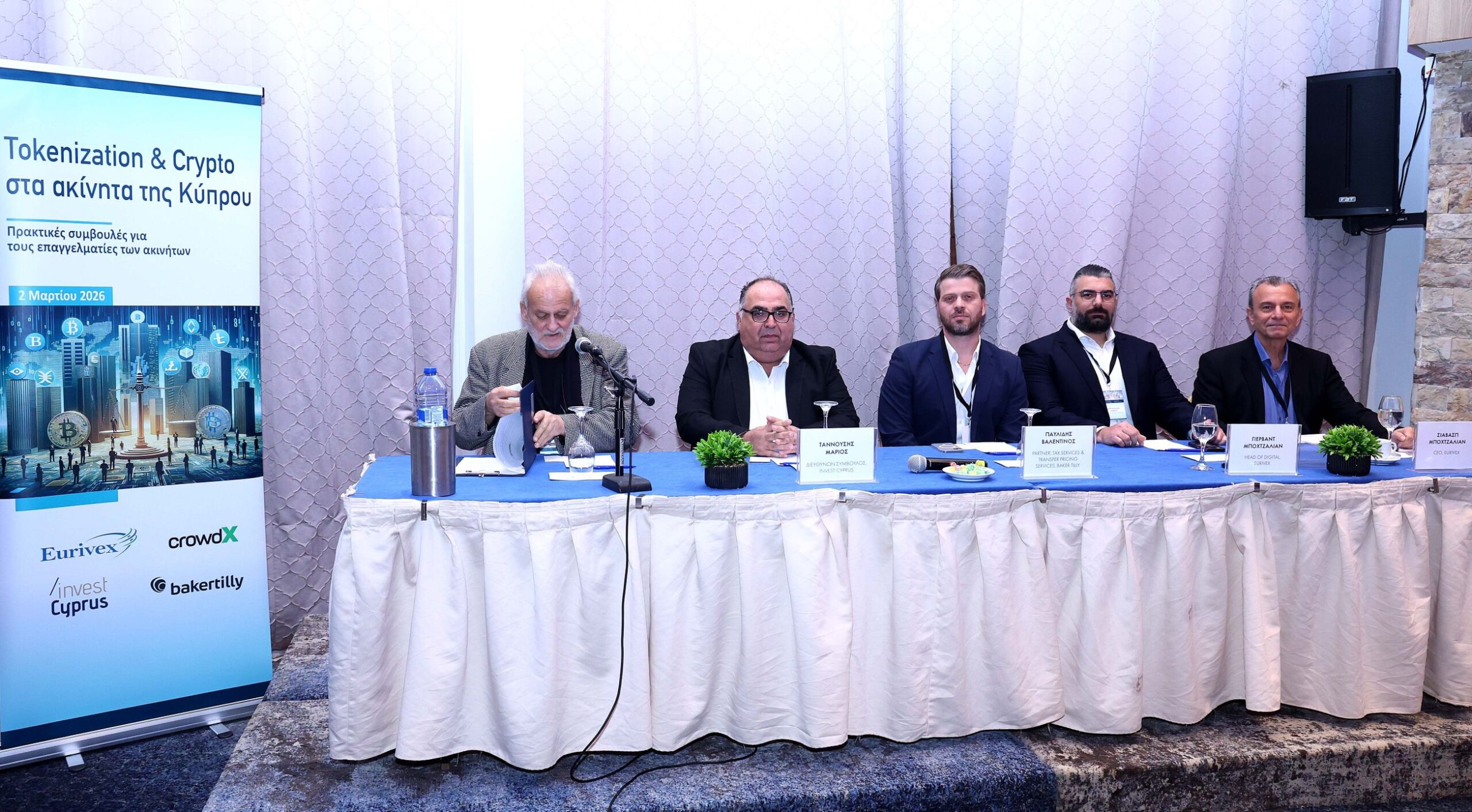

Cyprus property developers and real estate companies are discovering the fast and efficient world of tokenisation, with asset service providers (ASPs) explaining the benefits and new opportunities arising from buying digital tokens that each represent a fraction of a property.
For investors, you don’t need to buy a whole property to own a piece of it.
An event organised by advisors Eurivex / CrowdX covered topics such as attracting foreign investors to Cyprus using cryptocurrencies, tax issues related to crypto transactions and tokenisation, tokenisation and the issuance of security tokens.
Yervant Bohdjalian, Head of Digital at Eurivex, explained that tokenisation is the process of creating a digital equivalent of a real asset. The real estate tokenisation market is estimated to reach $1.7 trln by 2027, growing at an annual rate of 25%.
Some industry projections estimate that up to $4 trln in real estate could be tokenised by 2035, driven by digitisation and broader investor participation.
“Everyone acknowledges that digital securities are the future,” he said, adding that as real estate and other asset prices continue to rise, project owners need to find new ways to attract investment and alternative financing solutions.
“The Cyprus real estate market faces the same challenges. As prices continue to rise, one of the most effective alternatives is to tokenise properties and offer them to hundreds of investors,” he explained.
Instead of acquiring an entire apartment, the investor buys fractional shares. Each token entitles the investor to receive a proportional share of the income generated by the property (rents, capital gains from sales, etc.).
This makes investing in real estate much more accessible, especially for those who do not have large sums of money.
With blockchain technology and new platforms, anyone can buy digital tokens that represent a slice of a building, collect a share of the income, and even trade their tokens globally.
Security tokens (digital securities representing real assets) are a key element of this model. Thanks to blockchain, many of the processes in the real estate sector can be digitised, reducing costs and increasing transparency.
Foreign investors
One of the key issues facing developers and project owners in Cyprus is how they can accept and manage transfers of funds in crypto from foreign and local investors interested in acquiring real assets in Cyprus, such as real estate or shares in Cypriot companies.
Shavasb Bohdjalian, CEO of Eurivex, explained how project owners and investors can benefit from the regulatory framework offered by Eurivex, from asset protection, onboarding and project submission, to converting investments from cryptos to euros and transferring directly to project owners’ bank accounts.
“The last thing you want to tell a potential investor or buyer is that you don’t accept crypto or, worse, direct them to a gray market operator, thereby risking the investment being lost, blocked, or suspended,” he added.
The recent tax reform has created a more transparent methodology on how profits from crypto assets are taxed, said Valentinos Pavlides, Partner, Tax Services and Transfer Pricing at Baker Tilly, adding: “We now have clarity that profits from trading or from the increase in the value of crypto are subject to an 8% tax.”
Pavlides analysed in depth how the taxation of crypto fits into the overall taxation of a Cypriot company, with the basic corporate tax having increased to 15%. He also explained that, following the tax reform, the general tax-free amount has increased to €30,000 and to €150,000 for the disposal of a primary residence.
Marios Tanoussis, General Manager of Cyprus Invest, told participants that Cyprus has achieved excellent credit ratings from Moody’s (A3) and A- from S&P Global and Fitch, thanks to fiscal discipline.
The ICT and FinTech sectors have attracted many global companies, such as MUFG and Murex, among others. Cyprus has more than 40 trade agreements with the EU and over 65 double taxation agreements, while also developing a dynamic digital and research and development ecosystem.
“We want and aim to make Cyprus one of the best countries in the world to live, work and do business,” Tanoussis said.
With the Markets in Crypto-Assets Regulation (MiCA), companies within the European Union can now legally obtain licenses for cryptocurrency activities, thus creating a legal framework for asset service providers (ASPs).