
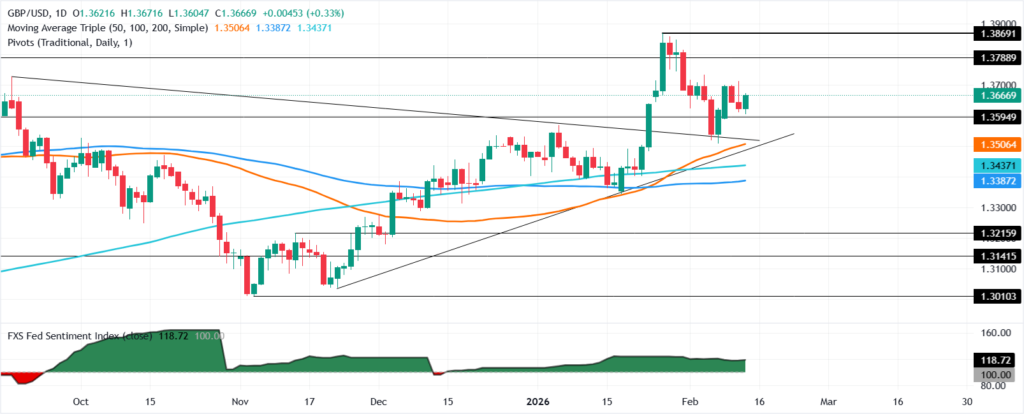
The Pound Sterling rallied during the North American session on Thursday against the dollar after new jobs data in the US contradicts a stellar nonfarm payrolls report released a day earlier.
The UK economy grew weaker than expected, yet the British pound continues to trade with gains, with GBPUSD at 1.3664, up 0.28%.
The pound modestly outperformed the euro, with the EURGBP cross trading near 0.8710.
The greenback extended losses after the latest Initial Jobless Claims report from the US Department of Labor witnessed a slight rise. Claims for the week ending February 7 rose by 227,000, down from a previous print of 232,000, but exceeded forecasts of 222,000.
The data is consistent with the recent trend. The jobless claims’ four-week average stands at around 219,500, and although it grew by 7,000 compared to the previous reading, the labour market shows signs of stabilising.
On Wednesday, the US Bureau of Labor Statistics (BLS) revealed that the US economy created over 130,000 new jobs, according to January’s NFP report. Consequently, the Unemployment Rate edged two tenths below the Fed’s 4.5% estimate for 2026.
 In the UK, gross domestic product (GDP) figures in Q4 2025 dipped from 1.2% to 1% YoY, below estimates of 1.2%. On a quarterly basis, the British economy grew 0.1%, unchanged from the quarter of July-September, beneath forecasts of 0.2% increase.
Given the backdrop and a dip in inflation data, it had pushed investors to increase bets that the Bank of England could cut interest rates sooner rather than later.
Money markets had priced in a 70% chance of a rate cut by the BoE at the March 19 meeting, according to Prime Market Terminal data.
Nick Rees, the Head of Macro at Monex, commented that politics are not creating a positive backdrop for GBP. He added that, “if we get the repeated stories about Keir Starmer’s judgments that resurrects the commentary and the speculation about him potentially being replaced, that’s still negative.”
On Friday, GBPUSD traders will eye US inflation figures. In the UK, the BoE Chief Economist Huw Pill would grab the headlines.
Preliminary figures suggest the UK economy lost momentum toward the end of 2025.
The disappointing data has added to pressure on the BoE, with markets increasingly pricing in the possibility of an interest-rate cut as early as March.
Attention now turns to preliminary Eurozone GDP data due on Friday, with markets looking for the economy to grow by 0.3% QoQ in the fourth quarter, unchanged from the previous reading. On an annual basis, GDP is expected to rise by 1.3% YoY, easing slightly from 1.4% previously.
Earlier on Thursday, comments from European Central Bank policymakers offered a cautiously reassuring backdrop for the Euro.
François Villeroy de Galhau said economic growth in the first quarter is expected to be consistent with an economy growing at around 1% on an annual basis in 2026. Meanwhile, Gabriel Makhlouf noted that inflation is basically on target at the moment, adding that the ECB is in a good place on policy.
The ECB is widely expected to keep policy on hold for an extended period. A Reuters poll conducted between February 9 to 12 showed that 66 of 74 economists expect the central bank to hold its deposit rate at 2.0% throughout 2026, and no change is expected before 2027.
(Source: OANDA)