

The EURUSD currency pair is practically flat on Thursday, trading at 1.1695, below the almost two-month highs above 1.1700 hit on Wednesday.
The risk-averse mood, triggered by downbeat earnings from Oracle, has offset investors’ optimism following a dovishly tilted monetary policy statement by the Federal Reserve.
Sales and revenue forecast released by the cloud computing giant Oracle on Wednesday missed market expectations. The company has made significant investments in AI technology, including a $300 bln deal with OpenAI, and plans to build AI data centres.
Fears of an AI bubble are back on the table, sending Asian equity markets lower and pointing to a negative session in Europe.
The risk-averse sentiment has provided some support to the safe-haven US dollar, which had tumbled against most currency peers, following a less hawkish-than-expected monetary policy decision by the Fed on Wednesday.
The US central bank cut interest rates by 25 basis points to the 3.50-3.75% range, as expected, but hawkish dissent was weak, and Chairman Jerome Powell showed more relaxed about inflation, which hints at further rate cuts in 2026.
The absence of a more hawkish divergence, with only two votes calling for steady rates, and Powell’s comments ruling out rate hikes, are keeping investors confident that the bank will cut rates at least twice more next year, as reflected on the CME Group FedWatch tool.
Beyond that, the market is also pricing the replacement of Jerome Powell by a more dovish Kevin Hassett at the end of his term in May. Hassett, the White House economic adviser, affirmed earlier this week that there is “plenty of room” to cut interest rates further.
The Fed also announced a bond-buying programme starting on December 12 with an initial round of $40 bln, aiming to support market liquidity, which took investors by surprise and added pressure on the USD.
In Europe, the ECB President, Christine Lagarde, stuck to her usual rhetoric while talking at the Financial Times Global Boardroom Conference in London on Wednesday.
She reiterated that the European Central Bank’s monetary policy remains in good shape and suggested that ECB officials might lift the region’s growth forecasts again, adding to evidence that the easing cycle has reached its end.
The European economic calendar is void on Thursday, while in the US, Initial Jobless Claims data will be observed with interest to confirm whether the previous week’s decline was due to the Thanksgiving holiday or it was a signal of some improvement in the labour market.
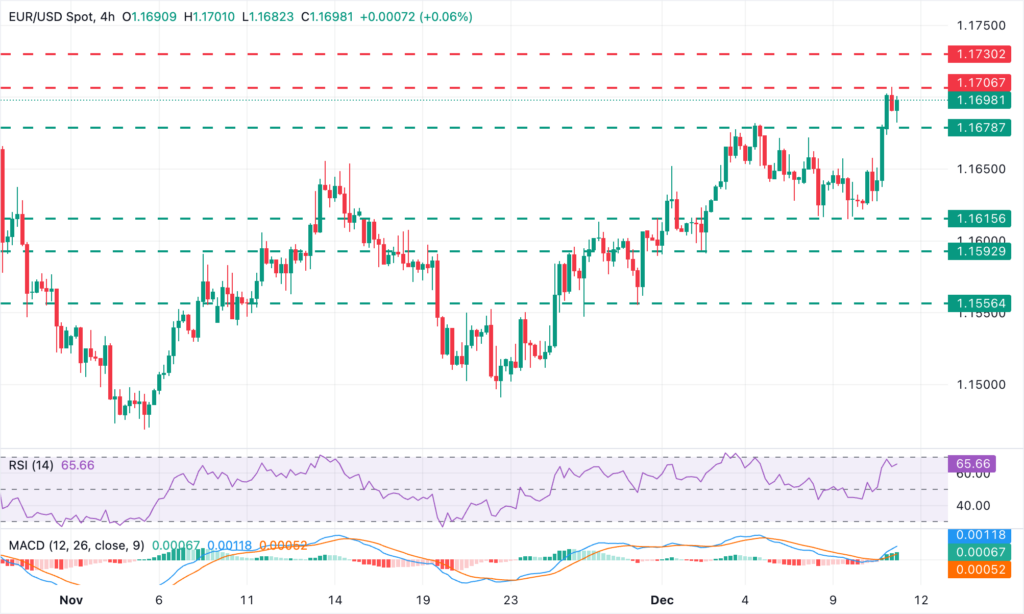 EURUSD charts by TradingView
(Source: OANDA)